Meet the hidden characters that lurk among the artist’s critically acclaimed London exhibition.
Someone somewhere had tricked London into thinking it was still summer. Horseguard’s Parade stretched out in the sun. Plane trees swayed lazily along The Mall. And tourists walked around in a daze not quite believing their luck.
It felt like one of those days when London could be the most beautiful place on earth.
But as I stepped into the galleries of the ICA, I entered a different world. One just as real and full of people, but in this curious landscape none could be seen.
I came across a couple – maybe lovers – decked out in cheap sportswear and pressed together in an intimate embrace
This was the universe created by Prem Sahib, the London-based artist, whose show Side On has transformed the white spaces of London’s ICA.
In, ‘Ghosts’, Henrik Ibsen’s seminal play, the character Mrs Helene Alving describes ‘dead ideas, and lifeless old beliefs’ that ‘cling to us’ as ghosts. ‘Whenever I take up a newspaper,’ she says, ‘I seem to see ghosts gliding between the lines. There must be ghosts all the country over, as thick as the sands of the sea.”
In a similar way, we encounter ghosts in Side On. But instead them being ‘dead ideas’ and ‘lifeless old beliefs’, they are real, contemporary and universal.
Walking around the gallery I came across a couple – maybe lovers – decked out in cheap sportswear and pressed together in an intimate embrace (Taken by Your Equivocal Stance I, II 2015, pictured below). But the precarious glass and delicately balanced ‘eggs’ (actually jesmonite and paint) suggests the fragility that comes with every human relationship. Maybe they’ll fall out tomorrow?
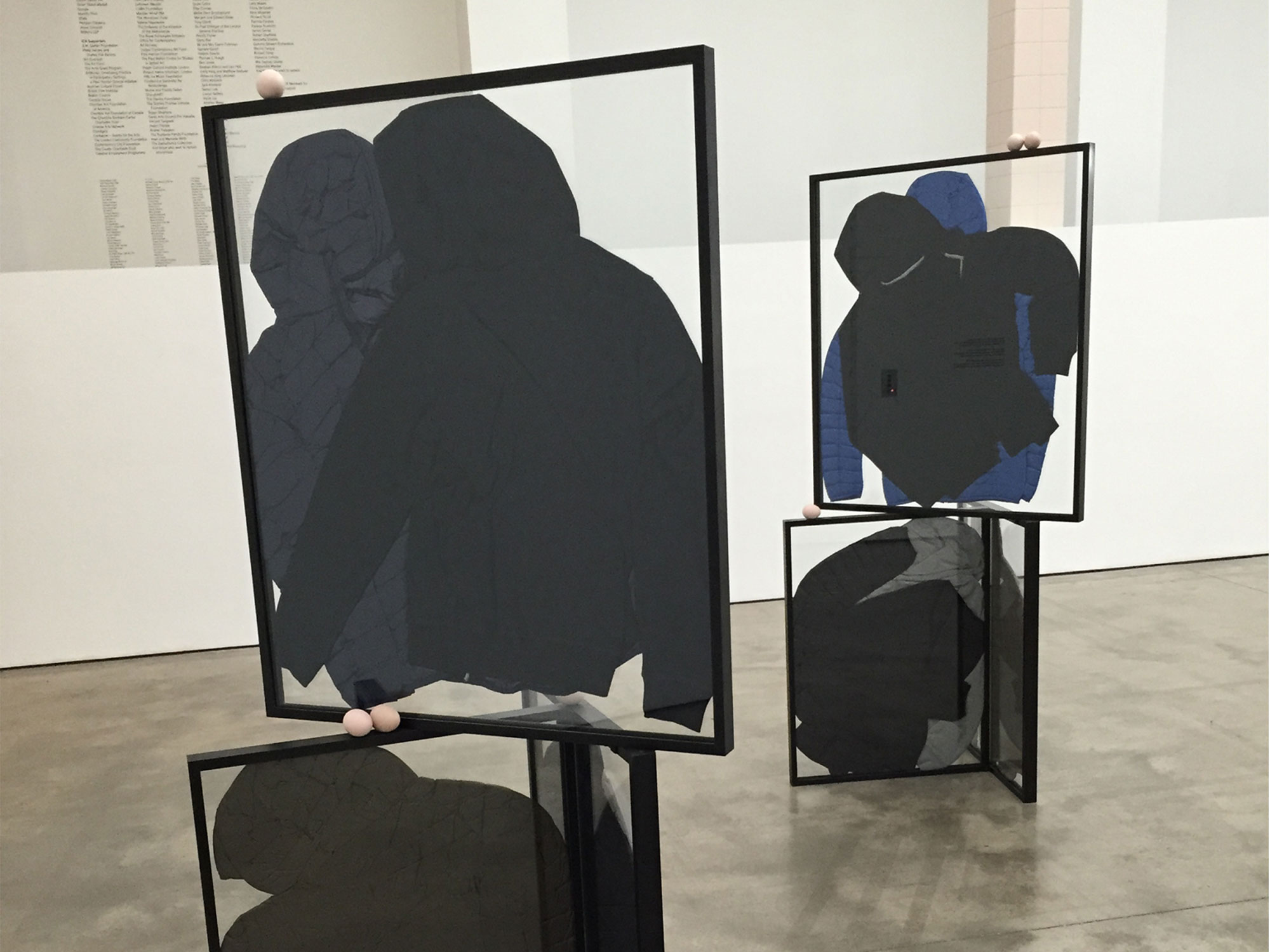
The total effect flickers between a sense of alienation and the warmth of humanity. It’s a very curious feeling. And I enjoyed it.
I also met a guy; and I’m guessing he’s hot (Spread 2015, pictured below). I say that because the sculpture echoed Allen Jones’ sexually provocative fibreglass furniture sculptures, such as Chair (1969; London, Tate). Only, as much as we might like to think he’s there entirely for our pleasure (male objectification – an unwelcome modern development: discuss), a strategically placed lead rod suggests that there’s a more reciprocal pleasure principle going on.

Often, we ourselves become the subjects. Looking For One 2015 (pictured below) focuses on a large structure that sums up both a louche Roche Bobois sofa and the functional, tiled, lounge areas of a gay sauna. Popcorn is strewn across the scene (to me referencing the collective voyeurism of the cinema). But, as if to make it clear that we are all complicit in having used the internet at some point or another to find ‘others’ (whether friends, love, or just sex), Prem includes a polished steel ‘laptop’, so polished in fact, that it reflects your image straight back at you.
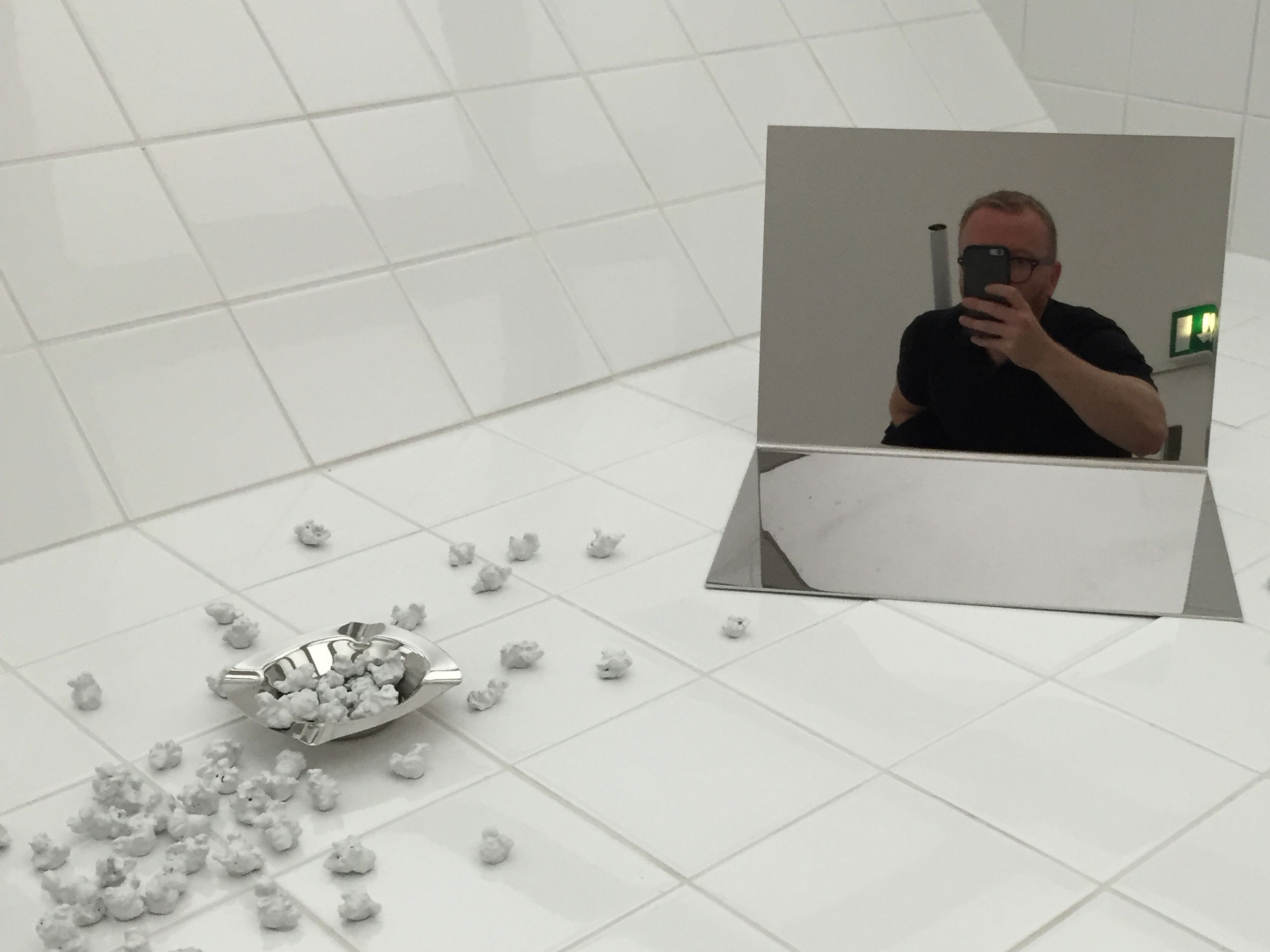
The total effect flickers between a sense of alienation and the warmth of humanity. It’s a very curious feeling. And I enjoyed it.
Similar sensations washed over when I came across Called Out 2015 (below left).
Called Out by Prem Sahib

Two minimalist structures that could be a distant cousin to Donald Judd and Tom Smith suddenly, before my eyes, became flushed with life. The position between them and the flesh-pink ceramic tiles that covered them evoked the classic harmony of an intwined couple, such as Boucher’s, Hercules and Omphale (c.1730). Only Prem’s choice of tiles are cheap and functional; the kind often found in student digs, local-authority leisure centres and gay bathhouses. This is a real couple. Not the fantasy of a Baroque painting. In fact, this scene is probably happening right now in Streatham, Bed-Stuy or Mumbai. (It gets even more intriguing when you realise a peeping tom (Watch Queen 2015, pictured below right) is eyeing them from afar. Maybe he / she is also in the bath house, a voyeur watching through the rising plumes of steam?)
Watch Queen (top left) by Prem Sahib

The subtle way Prem is able to infuse inanimate objects with the poetry and ambiguity of the human condition is sometimes challenging, but always fascinating. Side On offers a treasure trove of references to explore and a chance for us all to become voyeurs for a moment. But will we always like what we see?
 ZEFFADELICA